DAILY news HEALTH PORTATION news SOLAR PORTATION news TECH PORTATION news TRANS PORTATION news
AIR ART ANIMALS BEES BIRDS BOOKS CLIMATE EARTH ECONOMICS EDUCATION
ENERGY ENVIRONMENT FASHION GARDENS HOMES MOVIES MUSIC PERMACULTURE PEOPLE PLANTS SCIENCE SOCIAL SOLAR SPACE SUSTAINABILITY TECH TREES URBAN WATER WIND WORKWRITE
Showing posts with label Science. Show all posts

EARTH PORTATION curated News

0 comments
SCIENCE - Scientists show future events decide what happens in the past

“A future event causes the photon to decide its past.”
Cause and effect appear to be reversed. 
Time went backwards.
Andrew Truscott researcher scientists at the Australian National University said in a press release that they have proven that "reality does not exist if you are not looking at it.”
An experiment by Australian scientists has proven that what happens to particles in the past is only decided when they are observed and measured in the future. Until such time, reality is just an abstraction.
Particles can also tunnel through solid objects, which should normally be impenetrable barriers, like a ghost passing through a wall. And now scientists have proven that, what is happening to a particle now, isn't governed by what has happened to it in the past, but by what state it is in the future – effectively meaning that, at a subatomic level, time can go backwards.
Einstein called it "spooky" and Niels Bohr, a pioneer of quantum theory once said: “if quantum mechanics hasn’t profoundly shocked you, you haven’t understood it yet.”
Australia's New.com.au explains,
"Photons are weird. You can see the effect yourself when shining a light through two narrow slots. The light behaves both like a particle, going through each slot and casting direct light on the wall behind it — and like a wave, generating an interference pattern resulting in more than two stripes of light." a particle lacks definite physical properties and is defined only by the probabilities of it being in different states, it exists in a suspended state, a sort of super-animation until it is actually observed, at which point, it takes on the form of either a particle or wave, while still having the properties of both. 
"What makes a photon decide when to be one or the other?"
When a photon wave/particle is observed, it collapses, so it wasn't possible to see it in both states at once. Thus, it isn't possible to measure both the position of a particle and its momentum at the same time.
The Australian scientists set up an experiment similar to the double-slit one to try to estimate when particles took on a particle or wave form, but instead of using light, they applied helium atoms, which are "heavier" than light photons, in the sense that photons have no mass, whereas atoms do.
“Quantum physics predictions about interference seem odd enough when applied to light, which seems more like a wave, but to have done the experiment with atoms, which are complicated things that have mass and interact with electric fields and so on, adds to the weirdness.”the atom passed through it on many paths in a wave form, whether it continued as a particle or changed into a wave wasn't decided until a future event had already taken place. Time went backwards. Cause and effect appear to be reversed. The future caused the past. The arrow of time seemed to work in reverse.The decisive point when its form was decided was when the quantum event was observed and measured. Whatever would take place existed in a suspended state, the atom had not yet "decided" what to do.'
http://www.digitaljournal.com/science/experiment-shows-future-events-decide-what-happens-in-the-past/article/434829#ixzz3cU6VyRXR


http://www.digitaljournal.com/img/7/9/8/9/5/5/i/1/0/8/p-small/lhc.jpg


SCIENCE - Controversy over nitrogen's ocean 'exit strategies' resolved

0 comments

A decades-long debate over the dominant way that nitrogen is removed from the ocean may now be settled. Researchers found that both of the nitrogen 'exit strategies,' denitrification and anammox, are at work in the oceans. The debate centers on how nitrogen -- one of the most important food sources for ocean life and a controller of atmospheric carbon dioxide -- becomes converted to a form that can exit the ocean and return to the atmosphere wher ...

http://www.sciencedaily.com/releases/2014/04/140411092310.ht

SCIENCE - Forever clean? Metal–organic 'micromushrooms' repel all

0 comments

A clever chemical transformation yields surface-bound microstructures that efficiently drive away oil- and water-based contaminants. Natural surfaces that repel water, such as lotus leaves or butterfly wings, often have a rough, microscale texture that traps air beneath the liquid droplet. By mimicking these biological structures, researchers have developed 'superhydrophobic' coatings that are highly resistant to wetting. One trick unknown to nat ...

http://www.sciencedaily.com/releases/2014/04/140410160245.ht

SCIENCE - Greenland ice cores show industrial record of acid rain, success of US Clean Air Act

0 comments

Detailed ice core measurements show smog-related ratios leveling off in 1970, and suggest these deposits are sensitive to the same chemicals that cause acid rain. By analyzing samples from the Greenland ice sheet, atmospheric scientists found clear evidence of the U.S. Clean Air Act. They also discovered a link between air acidity and how nitrogen is preserved in layers of snow ...

http://www.sciencedaily.com/releases/2014/04/140411091840.ht

SCIENCE - 520-Million-Year-Old Fossils Had Heart and Brain

0 comments

An extinct arthropod, Fuxianhuia protensa, from the Cambrian period, had a sophisticated heart and blood vessel system ...

http://news.discovery.com/earth/rocks-fossils/520-million-year-old-fos

SCIENCE - Old toilets, other ceramic waste can be made into "greener" cement

0 comments

An international team of researchers has created a new type of cement that uses these discarded items that is just as strong, but produces far less emissions ...

http://www.treehugger.com/clean-technology/old-toilets-other-ceramic-w

SCIENCE - Trees go high-tech: Process turns cellulose into energy storage devices

0 comments

A fundamental chemical discovery should allow tress to soon play a major role in making high-tech energy storage devices. A method has been discovered to turn cellulose -- the most abundant organic polymer on Earth and a key component of trees –- into the building blocks for supercapacitors ...

http://www.sciencedaily.com/releases/2014/04/140407131027.ht

SCIENCE - New data show short-term value of scientific research

0 comments

University research is a key component of the US economic ecosystem, returning the investment through enormous public value and impact on employment, business, and manufacturing nationwide ...

http://phys.org/news/2014-04-short-term-scientific.htm

SCIENCE - When science and philosophy collide in a 'fine-tuned' universe

0 comments

When renowned scientists now talk seriously about millions of multiverses, the old question "are we alone?" gets a whole new meaning ...

http://phys.org/news/2014-04-science-philosophy-collide-fine-tuned-uni

SCIENCE - A new mathematics for experimental science

0 comments

Mathematics is the ultimate scientific tool. For centuries it has been used to describe the forces of nature, from planetary motion to fluid dynamics. It helped unlock the secrets of DNA and unleashed the Digital Revolution. Today, in the age of high-resolution detectors and international research collaborations, math again has the potential to transform science and accelerate discovery. But this work will require state-of-the-art mathematics, ca ...

http://phys.org/news/2014-04-mathematics-experimental-science.htm

SCIENCE - Overcoming structural uncertainty in computer models

0 comments

A computer model is a representation of the functional relationship between one set of parameters, which forms the model input, and a corresponding set of target parameters, which forms the model output. A true model for a particular problem can rarely be defined with certainty. The most we can do to mitigate error is to quantify the uncertainty in the model ...

http://phys.org/news/2014-04-uncertainty.htm

SCIENCE - ‘Synapses Lost and Found’ is theme of Gruber Science Fellowship Lecture

0 comments

"Synapses Lost and Found: Developmental Critical Periods and Alzheimer's Disease” is the topic of this year’s Gruber Science Fellowship Lecture, to be held 3:30 p.m. on Tuesday, April 22, in Luce Hall auditorium, 34 Hillhouse Ave ...

http://news.yale.edu/2014/04/01/synapses-lost-and-found-theme-gruber-s

SCIENCE - Evolution in morphological, optical, and electronic properties of ZnO:Al thin films undergoing a laser annealing and etching process

0 comments

Publication date: June 2014Source:Solar Energy Materials and Solar Cells, Volume 125 Author(s): C. Charpentier , R. Boukhicha , P. Prod?homme , T. Emeraud , J.-F. Lerat , P. Roca i Cabarrocas , E.V. JohnsonThe use of a combined excimer (XeCl=308nm) laser annealing (ELA) and chemical etching process (dubbed the “LaText” process) to generate textured ZnO:Al thin films suitable for thin-film silicon photovoltaic applications has been prev ...

http://rss.sciencedirect.com/action/redirectFile?amp;zone=main&cur

SCIENCE - New Way To Filter Light — First Directional Selectivity For Light Waves Achieved By Researchers

0 comments

An entirely new way to filter light, one that has long been sought but until now remained elusive, has been achieved by researchers at MIT.For the first time, it’s become possible to selectively filter light according to its direction of propagation — in other words, to filter it based on where it’s coming from.In this photo of the angular-selective sample (the rectangular region), a beam of white light passes through as if the sample was t ...

In this photo of the angular-selective sample (the rectangular region), a beam of white light passes through as if the sample was transparent glass. The red beam, coming in at a different angle, is reflected away, as if the sample was a mirror. The other lines are reflections of the beams. (This setup is immersed in liquid filled with light-scattering ­particles to make the rays visible). Image Credit: Weishun Xu and Yuhao Zhang

http://cleantechnica.com/2014/03/29/new-way-filter-light-first-directi

SCIENCE - New model reveals multiple compositional components of Earth's deep mantle being carried up to the surface

0 comments

Seeking to better understand the composition of the lowermost part of Earth's mantle, located nearly 2,900 kilometers (1,800 miles) below the surface, a team of Arizona State University researchers has developed new simulations that depict the dynamics of deep Earth. A paper published March 30 in Nature Geoscience reports the team's findings, which could be used to explain the complex geochemistry of lava from hotspots such as Hawaii ...

http://phys.org/news/2014-03-reveals-multiple-compositional-components

SCIENCE - Revolutionary Solar Cells Double as Lasers

0 comments

Commercial silicon-based solar cells – such as those seen on the roofs of houses across the country – operate at about 20% efficiency for converting the Sun’s rays into electrical energy. It’s taken over 20 years to achieve that rate of efficiency. A relatively new type of solar cell based on a perovskite material –.. ...

cambridge solar lasers research

http://solarthermalmagazine.com/2014/03/29/revolutionary-solar-cells-d

SCIENCE - Robot Guesses Mood, Wears Your Friend's Face

0 comments

SociBot-Mini's contoured plastic face can assume many identities, bringing a more human feel to telepresence. Continue reading ...

http://news.discovery.com/tech/robotics/robot-guesses-mood-wears-your-

SCIENCE - What Makes This Substance Boil And Freeze At The Same Time?

0 comments

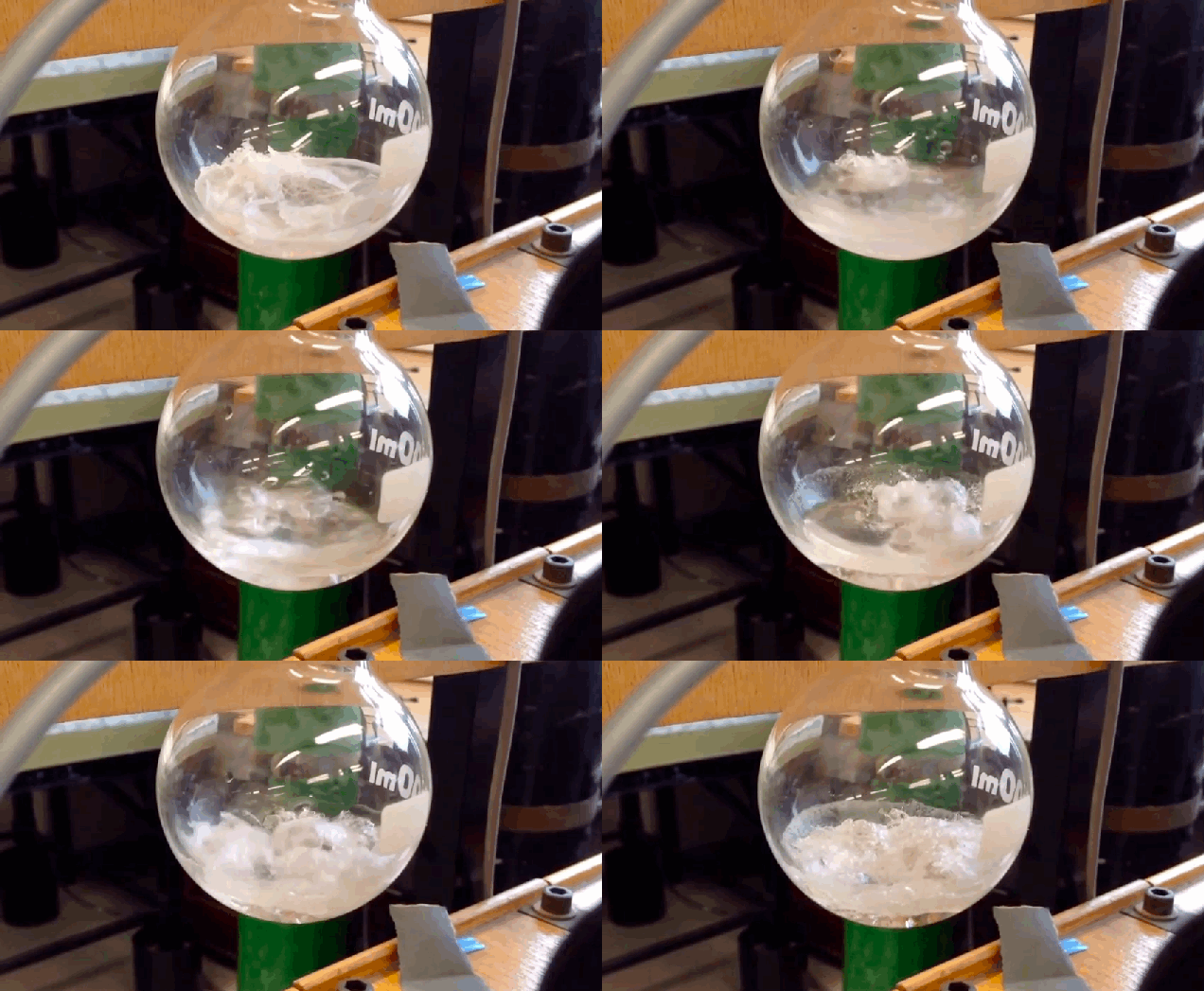
A mystery fluid is placed in a container and all the air is removed. The substance begins to freeze and boil at the same time. So what's going on?Read more...    ...

What Makes This Substance Boil And Freeze At The Same Time?

http://io9.com/what-makes-this-substance-boil-and-freeze-at-the-same-t

SCIENCE - How a 50-Cent Paper Microscope Could Save Millions of Lives

0 comments

Imagine if clinics in developing countries were equipped with an inexpensive yet durable tool that could help medical personnel identify and diagnose a variety of deadly diseases like Malaria, Chagas disease, or Leishmaniosis. Stanford professor Manu Prakash and his students have developed a virtually indestructible, super cheap, paper microscope and it may just be the ticket to saving a few millions lives ...

http://www.good.is/posts/how-a-50-cent-paper-microscope-could-save-mil

SCIENCE - Einstein's 'spooky' theory may lead to ultra-secure internet

0 comments

(Phys.org) —Einstein's scepticism about quantum mechanics may lead to an ultra-secure internet, suggests a new paper by researchers from Swinburne University of Technology and Peking University ...

http://phys.org/news/2014-03-einstein-spooky-theory-ultra-secure-inter

Copyright © EARTH Portation curated news - Blogger Theme by BloggerThemes & newwpthemes - Sponsored by Internet Entrepreneur